

The Fractured Landscape: Why Federal Leadership Is Essential for Cannabis Policy in America
The Fractured Landscape: Why Federal Leadership Is Essential for Cannabis Policy in America
As of mid-2026, cannabis remains a study in contradictions across the United States. While a growing majority of Americans support legalization, the plant exists in a fragmented legal reality shaped by decades of patchwork state actions and outdated federal prohibition.

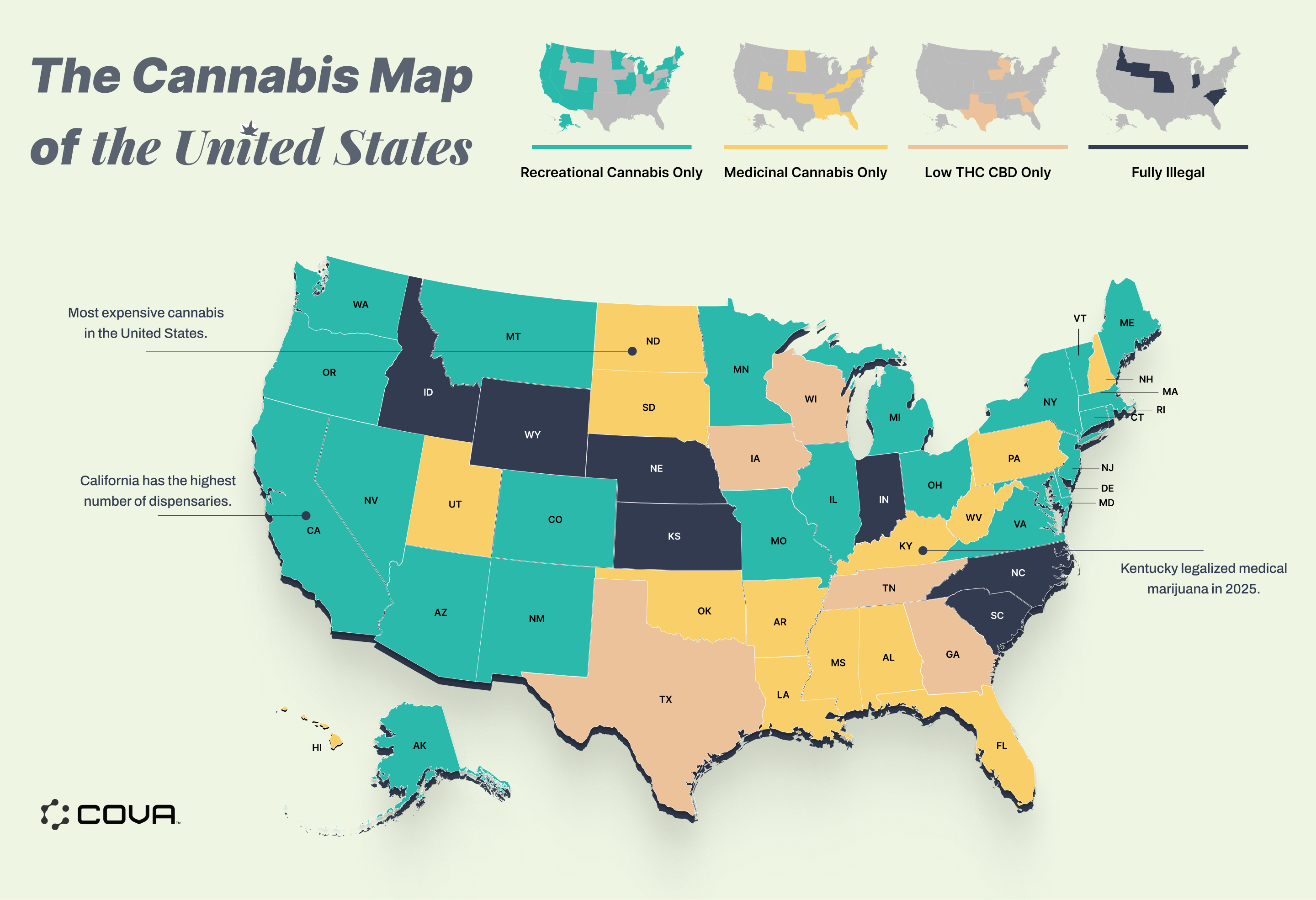

A Patchwork of Rules
Today, 24 states plus D.C., Guam, and the Northern Mariana Islands have legalized recreational cannabis for adults. Medical cannabis programs exist in around 40+ states and several territories. Yet nine states still lack even basic medical access, and a handful maintain near-total prohibition.
This state-by-state approach has created profound inconsistencies:
- Regulatory standards for testing, labeling, potency limits, and contaminants vary wildly.
- Tax rates, licensing structures, and possession limits differ dramatically from one border to the next.
- Banking and interstate commerce remain severely restricted due to federal law, forcing legitimate businesses to operate largely in cash.
- Patients and consumers face uncertainty when traveling: what is legal at home may become a federal or out-of-state crime elsewhere.
These disparities create confusion for consumers, compliance nightmares for multistate operators, and safety risks when products move across borders or when unregulated markets fill the gaps.


The Federal Barrier
At the federal level, cannabis is still classified as a Schedule I substance under the Controlled Substances Act — alongside heroin and LSD — despite recent administrative moves. In April 2026, the Justice Department took steps to place certain FDA-approved and state-licensed medical marijuana products into Schedule III, with hearings underway for broader rescheduling. While this is progress for research and some medical access, it stops far short of resolving the core conflict.
Federal prohibition continues to:
- Block interstate commerce
- Limit legitimate banking and financial services
- Create barriers for veterans, federal employees, and those in federally regulated industries (e.g., transportation)
- Undermine research and innovation due to outdated scheduling
The Case for Federal Governance
The current system fails the American people. A uniform federal framework — one that deschedules or legalizes cannabis nationally while respecting state autonomy — would deliver several critical benefits:
- Consistency and Safety: National standards for testing, labeling, and quality control would protect consumers far better than the current patchwork.
- Economic Opportunity: Legal interstate commerce and proper banking access would professionalize the industry, reduce the black market, and generate substantial tax revenue.
- Equity and Justice: Full federal reform must include expungement and reinvestment in communities disproportionately harmed by past prohibition policies.
- Public Health: Regulated access allows for better education, age restrictions, and harm reduction compared to prohibition or unregulated markets.
- Respect for Democracy: The American people have clearly spoken through state ballots and polls. Federal law should catch up and provide coherent national policy rather than forcing 50+ conflicting experiments.
A strong federal framework does not need to erase state differences entirely — states could still set their own taxes, licensing, and social policies — but it must remove the federal prohibition that currently hangs over the entire system like a legal sword of Damocles.
The time for half-measures and patchwork solutions is over. Congress and the executive branch should act decisively to end federal prohibition, establish sensible national guardrails, and finally grant Americans full, safe, and consistent access to cannabis.
The plant has waited long enough. The people have made their choice. Federal leadership must now deliver clarity, equity, and progress.
thestonerreview.com
What the Paperwork Actually Changes

Rescheduling headlines move markets. They do not automatically fix your local counter, your bank account, or your ability to grow at home. Read the bill text energy, not just the press release. Ask who profits when the suits celebrate.
Patients, Heads, and the Fine Print
Policy always lands unevenly. Veterans, legacy operators, and everyday smokers do not get the same windfall as companies with lobbyists. Track enforcement on the street, not just votes on the Hill.
Stay Fluent Without the Panic
Learn enough law to protect yourself. Skip the doomsday cosplay. Culture survived worse paperwork than this — and it will need clear heads more than hot takes.
One More Pass From the Notebook
We keep revisiting jars, floors, and fits because cannabis culture is not a press release — it is a practice. Come back tomorrow with a clearer nose, a sharper question, and less patience for potency theater. The Stoner Review will still be here, writing like the Wi-Fi might die and the circle outside is the only network that matters.
Support independent cannabis media when the algorithm gets weird. Share the pieces that help somebody shop smarter. And when a brand tries to sand the joke off the plant, remember who was in the room first.
Keep Reading on The Stoner Review
More field notes from the same smoke-stained notebook:
Find more gritty, honest stories, strain reviews, travel guides, and multi-minded stoner perspectives at theStonerReview.com/blog.


